
Most conversations about artificial intelligence oscillate between apocalyptic sci-fi scenarios and dense mathematical jargon. You hear terms like “neural architectures,” “latent vector embeddings,” and “backpropagation,” which make the technology feel like impenetrable magic.
It is not magic. Under the hood, artificial intelligence is essentially high-speed statistics combined with massive pattern recognition.
When you strip away the sales buzzwords, the AI applications you touch daily—from the predictive text finishing your emails to the GPS rerouting you around a highway accident—are solving practical problems using relatively simple core concepts. Here is a clear, human breakdown of how these everyday tools actually function.
1. Predictive Text and Chatbots: The World’s Most Sophisticated Autocomplete
Whether you are writing an email with autocomplete turned on or asking a conversational model like ChatGPT to draft a project proposal, you are using a Large Language Model (LLM).
Many people assume LLMs think like humans: that they form intentions, understand facts, and decide what to say. In reality, an LLM acts more like supercharged autocomplete.
How It Works Behind the Scenes
-
Tokenization: When you enter a prompt, the model splits your text into chunks called tokens (words, syllables, or even individual letters).
-
Context Mapping: The system converts each token into a list of numbers (a mathematical coordinate) that represents its meaning and relationship to other words. For example, “king” and “queen” sit close together in this mathematical space.
-
Probability Calculation: The model reads your input, considers the statistical likelihood of what should come next based on billions of pages of text it studied during training, and predicts the single most plausible next token.
Once it picks that next word, it feeds the whole sentence back into itself and guesses the next one. It repeats this loop dozens of times per second.
When a chatbot sounds poetic or remarkably articulate, it is not experiencing inspiration; it is calculating which sequence of words has the highest mathematical coherence based on its training data.
2. Streaming Recommendations: The Digital Fingerprint Match
When Spotify serves you a Monday morning mix or Netflix highlights a mini-series you end up binge-watching, it feels personal—almost uncanny.
Recommendation engines do not have taste or intuition. Instead, they rely on two primary techniques: Collaborative Filtering and Content-Based Filtering.
Collaborative Filtering: The “People Like You” Logic
Imagine you love Indie Folk and 90s Hip-Hop. The platform’s algorithm creates a vector—a digital fingerprint—of your listening habits. It then scans millions of other active profiles until it finds a group of users who share 90% of your specific taste profile.
If three of those users are obsessed with a brand-new indie band you have never played, the algorithm assumes you will like it too, and pushes it directly into your feed.
Content-Based Filtering: The Metadata Breakdown
Platforms also break down the content itself into granular tags:
-
Song tempo (BPM)
-
Key signature and acousticness
-
Movie genre, director, pacing, and color palette
By balancing what similar users consume with the exact characteristics of the content you linger on, the software serves options engineered to keep your attention on screen.
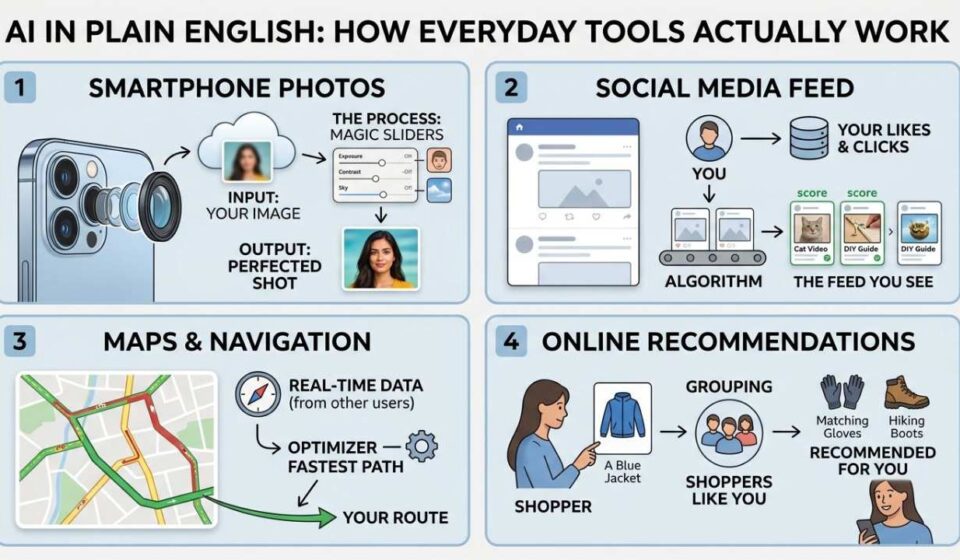
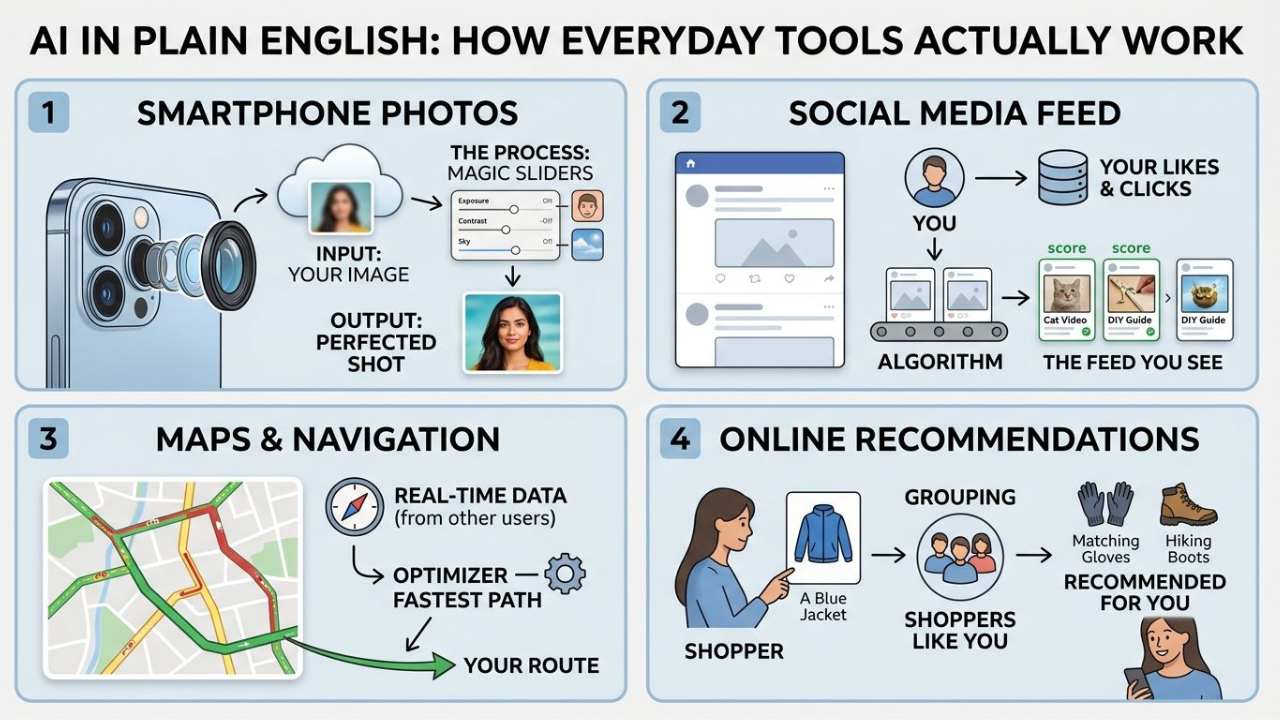
3. Smartphone Photography: Computational Photography Over Glass
Modern flagship phones take stunning, sharp photos in near-pitch darkness. But look closely at your phone’s camera bump: the glass lenses are smaller than a thumbnail, and the physical sensors are tiny compared to professional DSLR cameras.
Your smartphone does not take better photos because it has superior glass; it takes better photos because it relies on computational photography.
The moment you tap the shutter button, the camera sensor records dozens of frames in a split second. The onboard Neural Processing Unit (NPU) immediately gets to work:
-
Semantic Segmentation: The system classifies distinct areas of the frame—labeling hair, skin, fabric, greenery, and sky.
-
HDR Merging: It takes the sky from an underexposed frame (so the clouds aren’t blown out) and blends it with the shadow detail from an overexposed frame.
-
Denoising: It isolates visual digital noise in low light and smooths it out without blurring structural edges.
Your smartphone camera is not just capturing light; it is reconstructing a scene based on what a clean photograph ought to look like.
4. Navigation and Commuting: Graph Algorithms and Sensor Swarms
When Google Maps or Apple Maps tells you to turn left onto an obscure side street because your usual route is jammed, it is not using satellite camera feeds of the street in real-time.
Instead, it relies on two primary mechanics: Graph Theory and Aggregated Telemetry Data.
-
The Road Network as a Math Graph: Road systems are mapped mathematically as nodes (intersections) and edges (the roads connecting them). Every single road segment has a “cost” assigned to it—usually determined by travel time rather than physical distance.
-
Real-Time Fleet Data: Every active smartphone running the mapping app quietly transmits its GPS coordinates and velocity back to central servers. If 40 phones suddenly slow from 60 mph to 8 mph on a specific section of highway, the system immediately recalculates that road’s cost.
-
Dynamic Rerouting: Algorithms (like advanced variants of Dijkstra’s or A* search algorithms) constantly run alternative paths through the network graph to minimize total travel time before you even realize you would have been stuck in bumper-to-bumper traffic.
5. Email Spam Filters: The Unsung Guard Dog
Spam filtering was one of the earliest mass-market implementations of machine learning, and it remains one of the most effective.
Early filters looked for crude keyword triggers—like “free money” or “wire transfer.” Modern spam detection uses deep classification networks that review thousands of subtle signals simultaneously:
| Evaluation Signal | What the Filter Looks For |
| Sender Reputation | Domain validation records (DKIM, SPF, DMARC) and historic sender complaint rates. |
| Stylistic Syntax | Hidden zero-width spaces, mismatched character sets, or invisible font colors designed to fool filters. |
| Structural Anomalies | Odd ratios of image size to plain text, or links redirecting through multiple URL shorteners. |
| Behavioral Patterns | Whether recipients normally reply to or immediately delete messages with similar formats. |
By treating each email as a multi-dimensional puzzle rather than a simple checklist of banned words, modern filters stop upwards of 99% of spam before it ever reaches your sightline.
Frequently Asked Questions
Does AI actually “understand” what I am saying to it?
No. AI lacks consciousness, lived experience, and genuine comprehension. When an AI responds to your prompt, it interprets your words as mathematical patterns and responds with patterns that correlate well. It does not know what an apple tastes like or what sadness feels like; it simply knows how those concepts connect to other words in human writing.
Why do generative AI tools make up convincing lies (hallucinations)?
Because language models prioritize statistical plausibility over factual truth. If an AI does not find a definitive answer in its index, it generates words that fit the tone, rhythm, and structural context of a plausible answer. It is optimized to sound correct, not necessarily to be correct.
Is AI the same thing as Machine Learning?
Machine Learning (ML) is a specific branch of Artificial Intelligence. Think of AI as the broad goal—making computers perform tasks that require human-like judgment. Machine Learning is the primary modern method used to achieve that goal: feeding vast amounts of data into an algorithm so it learns rules on its own, rather than writing static rules manually.
How much personal data do these everyday tools need to work?
It depends on the tool. Generative chatbots need text prompts and feedback data to refine their behavior. Recommendation engines and navigation apps require ongoing streams of behavioral data (your listening history, clicks, and real-time location). Most modern platforms employ anonymization techniques, but the core functionality directly improves the more usage data it can evaluate.